Last Saturday, I had the pleasure of appearing at CDC Paranormal’s Sabbat des Sorcièresconference. It took place about twenty minutes away from the citadel of Carcassonne in Rieux-Minervois, a wine town that has, so far, been spared from the wildfires that have been sweeping through parts of Southern France. During my lecture, which I delivered in my characteristically discordant and staccatoed French (kudos to those who graciously endured it), I spoke about the significance of Roma Lister, Aradian mythology, and the so-called “archive of the witches”. I’ve included the English version of my talk below:
Thank you to the team at CDC Paranormal for inviting me. It gives me great pleasure to, in a way, conjure up the spirit of the American folklorist Charles Godfrey this evening. Some of you may know that Leland studied at the Sorbonne and fought in the war of 1848. He travelled widely in France, wrote and joked in French, and was in touch with a number of French scholars as a vice president of the Congrès International des Traditions Populaires. By all accounts, he was quite fluent in French. I, unfortunately, am not. So thank you in advance for bearing with my accent and mispronunciations.
This talk is about one of Leland’s most famous publications: Aradia, or The Gospel of the Witches. It is a curious book of myth, ritual, and folkloric miscellanea, described by Leland as part of a lost “scripture” of Italian witchcraft. Received with little fanfare in 1899, Aradia eventually caught the attention of occultists in the second half of the twentieth century as a result of the Wiccan priestess Doreen Valiente. Valiente was a passionate reader and interpreter of Leland and she used aspects of Aradia to rewrite certain Wiccan rituals. Subsequent to Valiente’s recovery of and repurposing of the text, Wiccans and other readers with interests in women’s liberation, social justice, and anti-capitalism found a kind of anthemic inspiration in its central myth, the import of which is feministic, anti-authoritarian, and anticlerical.
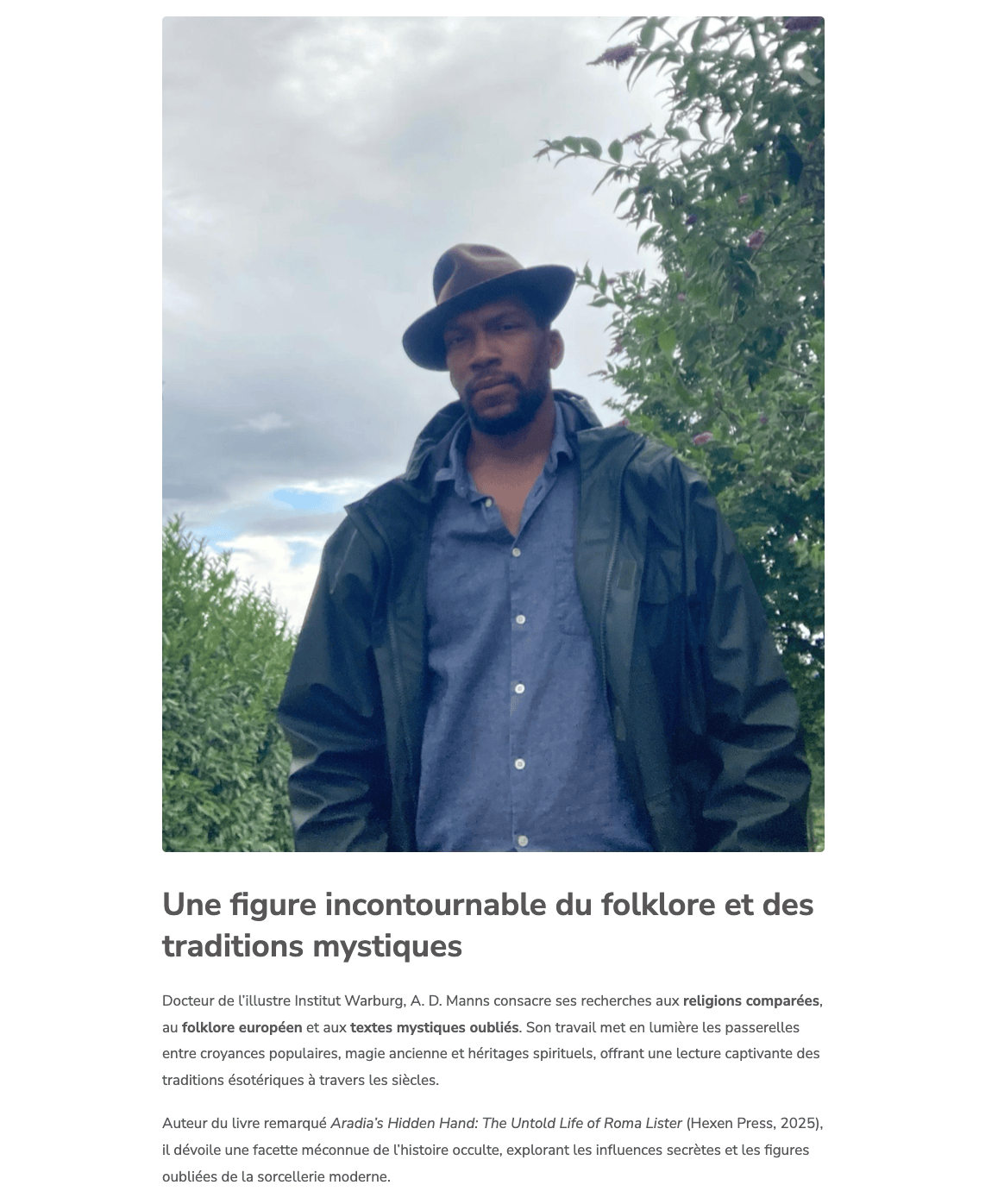
A.D. Manns and Kazim (publisher of Hexen Press) at CDC Paranormal. Photo by Franck Agier
It’s not surprising, therefore, that Aradia has had and continues to have a considerable impact on modern paganism. To be clear, when I say “modern paganism”, I am referring to forms of religious practices and spiritual beliefs which, while taking inspiration from the ancients, were only developed over the last three hundred years or so.
Aradia’s compelling central myth is as follows: The goddess Diana sends a saviour to Earth—her daughter, Aradia—to save humans from a powerful landowners and ecclesiastics. Diana gives them an instrument that makes the untouchable, touchable: sorcery. In a way, this gift transforms ordinary human beings into werewolf slayers.
What do I mean by this? In French folklore the werewolf is an unstoppable force, a juggernaut. To kill him, one normally needs supernatural cunning and bravery. The werewolf is defeated only when one steals his bewitched pelt or wounds him with a metal blade or bullet. Similarly, in the Aradian myth, magic is that divinely-apportioned weapon. Properly used, it brings down monsters, the real werewolves—political, social, and religious — that prey upon and plague society at-large.
The book itself, early reviewers were quick to observe, has chimeric qualities. In 1899 one reviewer called it a “modern remaniement”, and in 1902 the French archaeologist Henri Hubert said it was a composite work whose contents appeared disparate, cobbled together from independent sources. Some parts do indeed seem older than others, and the text is full of Leland’s copious comments and acknowledgements of creative liberty. “This section wasn’t part wasn’t originally part of the Witches Gospel,” he remarks from time to time, “but I’m adding its because it should be.” Leland felt it was legitimate to do so because his additions originated from what he called the “archives of the witches”, information produced from oral interviews with practising witches.
Leland assembled the book from a manuscript he reportedly received from one of his trusted informants—a Tuscan fortune-teller named Maddalena—in 1897. Scholarship has established Maddalena’s existence, but as it stands, we still know very little about her background and the extent of her involvement in the text’s production.
In my recent book, Aradia’s Hidden Hand: The Untold Life of Roma Lister, I explore the authorship question by examining the life of Roma Lister, a little-known British-Italian folklorist, writer, and friend of Leland. A cosmopolitan and socialite, she moved in high society circles in Rome and Florence, counting diplomats, artists, scholars and other influential figures as her friends. At the same time, she cultivated a network of local informants, many of whom provided her with information about traditions of vernacular magic in the Italian countryside. Lister, I think, should be seen as a crucial disseminator of the “witches’ archive” that I referred to earlier.
It’s not just that she collected folklore for Leland. Occasionally, Leland also asked her to transcribe and translate manuscripts from Maddalena. This means that Leland didn’t always work from the original sources. Sometimes the material to which he adjoined comments and incorporated into his books (his Legends of Florence, for example) were actually Lister’s renditions of primary texts. Thus, Lister’s own interpretation of sources helped to shape Leland’s understanding of the forms of Italian folk magic.
In addition to her research activities, Lister also practised magic, employing the use of crystal balls, tarot cards, and spellcraft to assist or provide guidance to friends and family. Given that she also received lessons in “the black art” (as Leland put it) from Maddalena, one can assume that at least part of her overall magical outlook at the time originated with Maddalena, a professed witch.
Lister’s other major influences included Theosophy and spiritualism. She became a skilled medium, often collaborating with her aunt Julia Rosenkrantz (also a medium), and her friend, Lady Walburga Paget, a German-British Theosophist and noblewoman. I first brought this to the public’s attention in 2022 in an article for my blog, The Thinker’s Garden. In my book, however, I go into greater detail, shedding light both on her earliest mediumistic experiences as well as the psychic training that she received. Since Lister was already conducting seances and automatic writing sessions at the time with other people, I also explore the very real possibility that Lister channelled aspects of Aradia. I won’t go into my conclusions here; you’ll have to read the book.
In any case, apropos Lister’s role in contributing to the sea of ideas in which Aradia first emerged, the following can be said with confidence. One, Lister had special access to communities and persons in Italy who believed themselves to be custodians of specialist occult knowledge. Lister herself became in a sense an inheritor and transmitter of this knowledge. As such, she became one of the select few who helped fashion the “witches’ archive”. The significance of this can’t be overstated. There was no set, official historical witch “archive” that existed independently of Leland’s studies. Built and shaped by Leland’s sources, the witches’ archive in actuality constituted an aggregate of folk beliefs, hearsay, and know-how. It was absolutely indispensable, and without contributions like Lister’s and Maddalena’s, Leland would not have been able to produce works like Aradia or his other books on Italian folklore and occultism.